




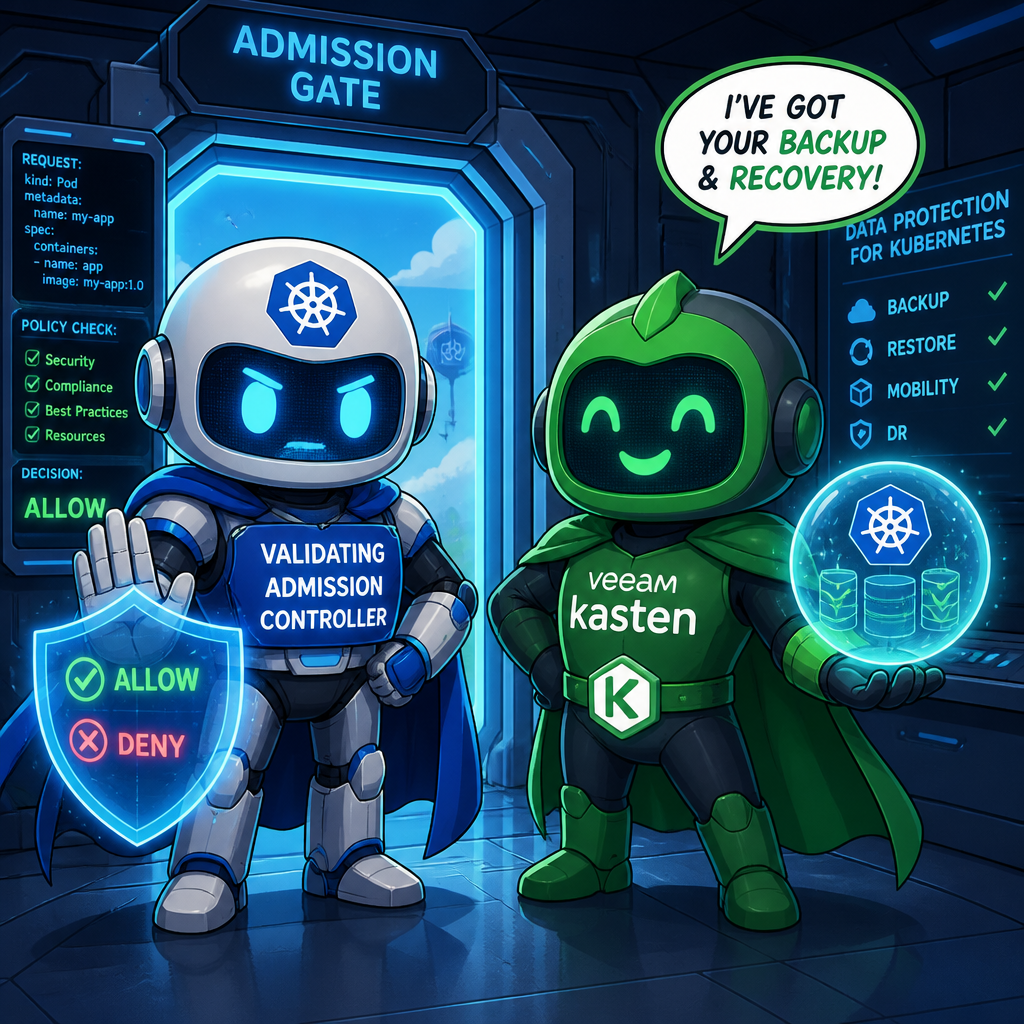
Many operations in your cluster will likely pass through admission control. Someone creates a Deployment with a :latest tag, forgets a resource limit, or tries to delete a namespace they don’t own — Kyverno, Gatekeeper, or a ValidatingAdmissionPolicy catches it before the object is ever persisted. Until now, backup and restore operations were the exception. A user with the right RBAC could kick off a RestoreAction into any namespace, or delete a RestorePoint ahead of its retention window, and no policy engine ever saw the request.
Veeam Kasten v9.0 closes that gap. This release ships Admission Controller Policy Enforcement for Backup and Restore Operations as a Technical Preview, building on the Validating Admission Policy work Kasten introduced in v8.0 for self-service migrations. With it enabled, Kasten’s Action and RestorePoint resources are evaluated by whichever policy engine your platform team already runs — Kyverno, OPA Gatekeeper, or Kubernetes-native Validating Admission Policies — at admission time, before the operation executes.
This post walks through why that matters, how it works under the hood, and how to stand up all three policy engines against a KinD cluster to see it in action.
Why This Matters
Kasten’s Policy and Profile objects are regular CRDs, so they’ve always been subject to normal Kubernetes admission control. Actions (BackupAction, RestoreAction, RunAction, and friends) and RestorePoints, however, are served by Kasten’s aggregated API server rather than the built-in CRD machinery. Historically, that meant policy engines simply never saw them — you could write a Kyverno policy targeting RestoreAction all day long, and it would silently never fire.
With admission controller support enabled in v9.0, platform teams can now enforce guardrails such as:
- Preventing creation of a backup
Policyunless it excludes sensitive resource types likeSecrets. - Requiring that a
RestoreAction’s target namespace matches a naming convention, such as sharing a prefix with the namespace the backup was taken from. - Stripping sensitive resource types out of a restore by mutating the request’s filters.
- Requiring an expiration on manual
RunActionoperations so ad hoc backups don’t orphan data indefinitely. - Blocking deletion of
RestorePointsbefore their retention window has passed.
In other words: the same governance model your platform team already applies to every other workload now extends to data protection.
How It Works
When enabled, Kasten routes requests against its aggregated API resources through the standard Kubernetes admission chain:
| API Group | Resources |
|---|---|
actions.kio.kasten.io/v1alpha1 |
BackupAction, BackupClusterAction, BatchRestoreAction, CancelAction, ExportAction, ImportAction, MigrateFCDAction, ReportAction, RestoreAction, RestoreClusterAction, RetireAction, RunAction, StageAction, UpgradeAction, ValidateAction |
apps.kio.kasten.io/v1alpha1 |
Application, ClusterRestorePoint, RestorePoint, RestorePointContent |
dr.kio.kasten.io/v1alpha1 |
KastenDRRestore, KastenDRReview |
repositories.kio.kasten.io/v1alpha1 |
StorageRepository |
vault.kio.kasten.io/v1alpha1 |
Passkey |
A few important details before you flip the switch:
- Requests made directly against these resources (
kubectlor the Kasten dashboard) are evaluated before the object is persisted, exactly like any other admission-controlled resource. - Some of these resources are also created indirectly by Kasten itself. A scheduled policy run creates a
BackupAction; deleting aRestorePointContentcreates aRetireAction. Kasten validates these internal operations against your policies too, using Kubernetes dry-run requests — which means any webhook targeting these resources must declaresideEffects: NoneorsideEffects: NoneOnDryRun, or the dry-run call will be skipped and the real operation will fail. - Kasten aggregated API resources don’t support updates after creation, so policies should target
CREATEandDELETEoperations only. - Because internal service-account traffic is also evaluated, an overly broad policy can break scheduled backups, restores, or retirements. Exempt Kasten’s own service accounts (the
system:serviceaccounts:kasten-iogroup covers all of them) from anything meant to constrain end users only, and consider running new policies in audit/warn mode before switching to enforce.
This is still a Technical Preview: expect rough edges around error messages surfaced in the dashboard, and don’t rely on it for production enforcement yet.
Demo: Three Policy Engines on One KinD Cluster
The rest of this post assumes you already have a KinD cluster running with Kasten v9.0 installed. We’ll enable the admission controller feature, then implement the same guardrail — block deletion of RestorePoint/RestorePointContent by anyone other than Kasten’s own service accounts or a cluster-admin — three different ways so you can compare the engines side by side.
If you’re building the cluster from scratch, this kind-config.yaml is worth using since it pins a Kubernetes version with Validating Admission Policy at GA and leaves room to opt into Mutating Admission Policy on older releases via feature gate:
# kind-config.yaml
kind: Cluster
apiVersion: kind.x-k8s.io/v1alpha4
nodes:
  - role: control-plane
    image: kindest/node:v1.31.0
    kubeadmConfigPatches:
      - |
        kind: ClusterConfiguration
        apiServer:
          extraArgs:
            feature-gates: "ManifestBasedAdmissionControlConfig=true"
  - role: worker
kind create cluster --config kind-config.yaml --name kasten-admission-demo
Step 1 — Enable the Kasten Aggregated API Admission Controller
This is off by default because enabling it immediately activates any existing policy that happens to match Kasten’s API groups, including ones nobody realized were dead code:
helm upgrade k10 kasten/k10 -n kasten-io \
  --reuse-values \
  --set services.aggregatedapis.admissionController=true
If you also want to try the Kubernetes Mutating Admission Policy feature against these resources (useful for the “strip sensitive resource types from a restore” pattern):
helm upgrade k10 kasten/k10 -n kasten-io \
  --reuse-values \
  --set services.aggregatedapis.mutatingAdmissionPolicy=true
Step 2 — Option A: Kyverno
Install Kyverno:
helm repo add kyverno https://kyverno.github.io/kyverno/
helm repo update
helm install kyverno kyverno/kyverno -n kyverno --create-namespace
Apply the guardrail. This is the policy pattern Kasten documents directly — it matches DELETE operations on the aggregated RestorePoint/RestorePointContent resources and excludes Kasten’s own service accounts and cluster-admin so retention and retirement processing still work:
# kyverno-block-rp-deletion.yaml
apiVersion: kyverno.io/v1
kind: ClusterPolicy
metadata:
  name: block-rp-deletion-users
  annotations:
    policies.kyverno.io/title: Block User RestorePoint Deletion (Allow K10 System Accounts)
    policies.kyverno.io/description: >-
      Blocks deletion of RestorePoints by regular users while allowing any K10 service
      account (system:serviceaccounts:kasten-io group) and cluster-admin to delete.
spec:
  validationFailureAction: Enforce
  background: false
  rules:
    - name: deny-user-restorepoint-deletion
      match:
        any:
          - resources:
              kinds:
                - apps.kio.kasten.io/v1alpha1/RestorePoint
                - apps.kio.kasten.io/v1alpha1/RestorePointContent
              operations:
                - DELETE
      exclude:
        any:
          - subjects:
              - kind: Group
                name: system:serviceaccounts:kasten-io
          - clusterRoles:
              - cluster-admin
      validate:
        message: >-
          Only K10 service accounts (system:serviceaccounts:kasten-io) or
          cluster-admin may delete RestorePoints. User deletions are blocked.
        deny: {}
kubectl apply -f kyverno-block-rp-deletion.yaml
Step 2 — Option B: OPA Gatekeeper
Install Gatekeeper, enabling its delete webhook since Gatekeeper doesn’t intercept DELETE requests by default:
helm repo add gatekeeper https://open-policy-agent.github.io/gatekeeper/charts
helm repo update
helm install gatekeeper gatekeeper/gatekeeper -n gatekeeper-system --create-namespace \
  --set enableDeleteOperations=true
Define a ConstraintTemplate implementing the same logic in Rego:
# gatekeeper-constrainttemplate.yaml
apiVersion: templates.gatekeeper.sh/v1
kind: ConstraintTemplate
metadata:
  name: k8skastenrestorepointdeleteguard
spec:
  crd:
    spec:
      names:
        kind: K8sKastenRestorePointDeleteGuard
  targets:
    - target: admission.k8s.gatekeeper.sh
      rego: |
        package kastenrestorepointdeleteguard

        violation[{"msg": msg}] {
          input.review.operation == "DELETE"
          not is_kasten_service_account
          not is_cluster_admin
          msg := "Only Kasten service accounts (system:serviceaccounts:kasten-io) or cluster-admin (system:masters) may delete RestorePoints. User deletions are blocked."
        }

        is_kasten_service_account {
          input.review.userInfo.groups[_] == "system:serviceaccounts:kasten-io"
        }

        is_cluster_admin {
          input.review.userInfo.groups[_] == "system:masters"
        }
Then the Constraint that binds it to Kasten’s aggregated API:
# gatekeeper-constraint.yaml
apiVersion: constraints.gatekeeper.sh/v1beta1
kind: K8sKastenRestorePointDeleteGuard
metadata:
  name: block-rp-deletion-users
spec:
  match:
    kinds:
      - apiGroups: ["apps.kio.kasten.io"]
        kinds: ["RestorePoint", "RestorePointContent"]
kubectl apply -f gatekeeper-constrainttemplate.yaml
kubectl apply -f gatekeeper-constraint.yaml
Step 2 — Option C: Native Kubernetes ValidatingAdmissionPolicy
No extra components to install here — this uses the admission chain built into the API server. Define the policy:
# vap-block-rp-deletion.yaml
apiVersion: admissionregistration.k8s.io/v1
kind: ValidatingAdmissionPolicy
metadata:
  name: kasten-restorepoint-delete-guard
spec:
  failurePolicy: Fail
  matchConstraints:
    resourceRules:
      - apiGroups:   ["apps.kio.kasten.io"]
        apiVersions: ["v1alpha1"]
        operations:  ["DELETE"]
        resources:   ["restorepoints", "restorepointcontents"]
  variables:
    - name: isKastenServiceAccount
      expression: "request.userInfo.groups.exists(g, g == \"system:serviceaccounts:kasten-io\")"
    - name: isClusterAdmin
      expression: "request.userInfo.groups.exists(g, g == \"system:masters\")"
  validations:
    - expression: "variables.isKastenServiceAccount || variables.isClusterAdmin"
      messageExpression: "\"Only Kasten service accounts (system:serviceaccounts:kasten-io) or cluster-admin (system:masters) may delete RestorePoints. User deletions are blocked.\""
---
apiVersion: admissionregistration.k8s.io/v1
kind: ValidatingAdmissionPolicyBinding
metadata:
  name: kasten-restorepoint-delete-guard-binding
spec:
  policyName: kasten-restorepoint-delete-guard
  validationActions: ["Deny"]
kubectl apply -f vap-block-rp-deletion.yaml
Step 3 — Verify the Policy Is Enforced
Whichever engine you picked, the behavior should look the same from the caller’s side. Impersonate a regular user and try to delete a RestorePoint created by an earlier backup run:
kubectl delete restorepoint <restore-point-name> -n <app-namespace> \
  --as jamie --as-group developers
Expect a denial similar to:
Error from server: admission webhook denied the request:
Only K10 service accounts (system:serviceaccounts:kasten-io) or
cluster-admin may delete RestorePoints. User deletions are blocked.
Then confirm Kasten’s own retirement flow still works by letting a policy’s retention rule retire an expired restore point normally, or by deleting it as cluster-admin:
kubectl delete restorepoint <restore-point-name> -n <app-namespace> \
  --as admin --as-group system:masters
That second call should succeed — proof that the guardrail targets end users without breaking Kasten’s internal retention and retirement processing.
What to Keep in Mind
A few caveats worth internalizing before you take this beyond a KinD sandbox:
- This is a Technical Preview. The configuration surface, CRD coverage, and dashboard error reporting are all still in motion — don’t build production enforcement on it yet.
- Enabling
services.aggregatedapis.admissionController=trueactivates every existing policy that matcheskio.kasten.ioAPI groups at once. Audit what’s already deployed in your cluster before flipping it on, and consider running new rules in Kyverno’sAuditmode or a ValidatingAdmissionPolicyWarnaction first. - Webhooks must be dry-run safe (
sideEffects: NoneorNoneOnDryRun). Kasten validates its own internal operations via dry-run, and a webhook that can’t handle that will simply be skipped for those requests — which usually isn’t what you want. - Kasten aggregated API resources don’t support in-place updates, so scope your policies to
CREATEandDELETE. - Remember to exempt
system:serviceaccounts:kasten-iofrom any policy meant to constrain end users, or you risk breaking scheduled backups and retention processing.
Where to Go Next
The pattern above — governing Actions and RestorePoints the same way you govern every other cluster resource — opens the door to a lot more than access deletion. Combine it with the label-based backup opt-out approach from our earlier Kyverno post and you’ve got a genuinely comprehensive policy layer covering who can back up what, who can restore where, and who can delete recovery points and when.